Co-designing a listing-centric view (iOS)
As the Product Designer leading strategy for Real Time Agent, I drove a platform-wide redesign of the Information Architecture through a co-design process deeply informed by user research.
The Challenge
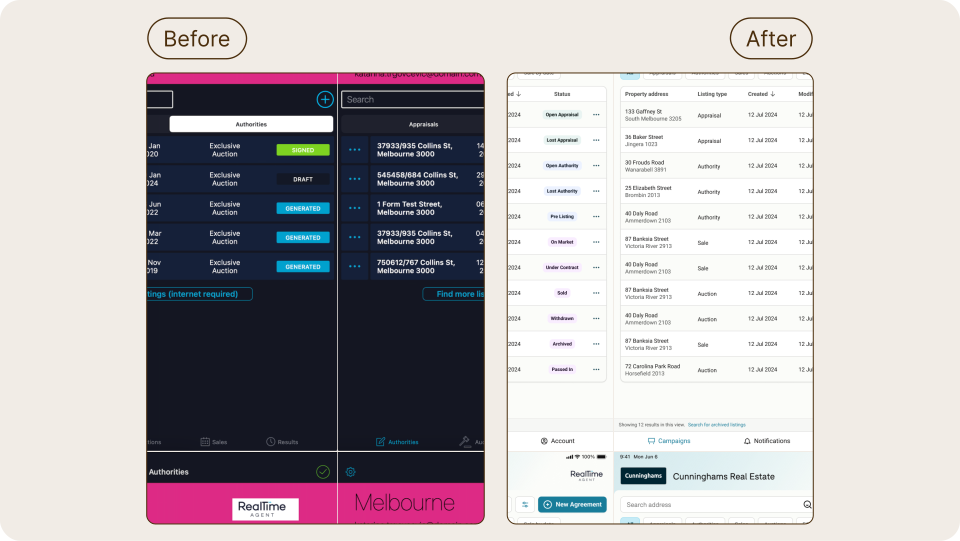
The existing IA reflects a start-up phase approach, with features added reactively in response to customer requests, rather than through a holistic understanding of how Agents actually think and work. As a result, key workflows are fragmented across multiple tabs (Agreements, Auctions, Sales, and Results), with no unified view of the listing journey. This fragmentation leads to unnecessary cognitive load, slower task completion and a disjointed user experience.
My Role
I led the discovery and strategic direction for a platform-wide IA shift, partnering closely with Product, Tech, Support and Commercial. I was responsible for:
- Framing the problem beyond surface-level usability issues to a system-level challenge
- Defining and validating a new IA direction grounded in user mental models
- Leading a co-design research approach to de-risk the concept early
- Translating insights into a scalable, object-oriented framework
- Building alignment and momentum across teams through shared understanding
Proposed Solution
One property. Everything under it.
We designed a listing-centric IA where the property is the central object - unifying Agreements, Auctions and Sales into one cohesive view, so agents can manage everything in one place.
Fostering a Customer-Centric Culture
"Big cheers to Kat and Jen for facilitating all of the agent interviews for RTA. We are learning so much about how agents use our product and their frustrations and things they love. I hope we get to do even more of these into the future. They have been so valuable." — Nat, Tech Lead
We live-streamed all interview sessions with the team to ensure they directly observed the research process. This fostered empathy and a shared understanding of pain points - a crucial step in generating buy-in for a major IA shift.
Key Insights
Through research and testing, we validated our core hypothesis: that a listing-centric IA improves usability and helps agents focus on high-value tasks.
"It should just be one address with everything under it... and then auctions could even have authority to bids, all within that one property profile."
"You have one property address for each property, and it has everything in there, you don't have multiple tabs, and then you can come in here and generate another agency agreement, you can do it all from within the one property."
"I'm sure there's a better workflow where it's not in multiple locations, like if you have it in a sense, a master folder or a master property."
Design Principles
Mental Model Alignment
Anchor the experience around the property as the single source of truth.
Seamless Workflow Transitions
Allow listings to evolve naturally across stages, with the system dynamically reflecting status changes.
Contextual Visibility
Surface the right information and actions at the right time, within the listing.
Reduced Cognitive Load
Simplify navigation and eliminate the need to jump between disconnected areas.
Efficiency Through Personalisation
Enable filters, default views and contextual actions tailored to agent workflows.
Reflection
Designing with users, not just for them
This project reinforced the importance of designing around user mental models rather than internal structures. By embedding the voice of the customer into our process, we created not only a more intuitive IA, but a team culture grounded in customer-centricity, empathy and continuous learning.
This foundation now enables the team to build scalable, intuitive and consistent experiences across all platforms (Web and iOS) moving forward.